SabeeApp research on how AI will change tourism and the hotel industry
Artificial intelligence has become a buzzword in the hospitality world, but what do accommodation providers actually think about it? To find out, SabeeApp hotel management system has conducted an industry research among accommodation providers in Hungary. The responses paint an interesting picture of the industry, and it’s filled with curiosity and future opportunities.
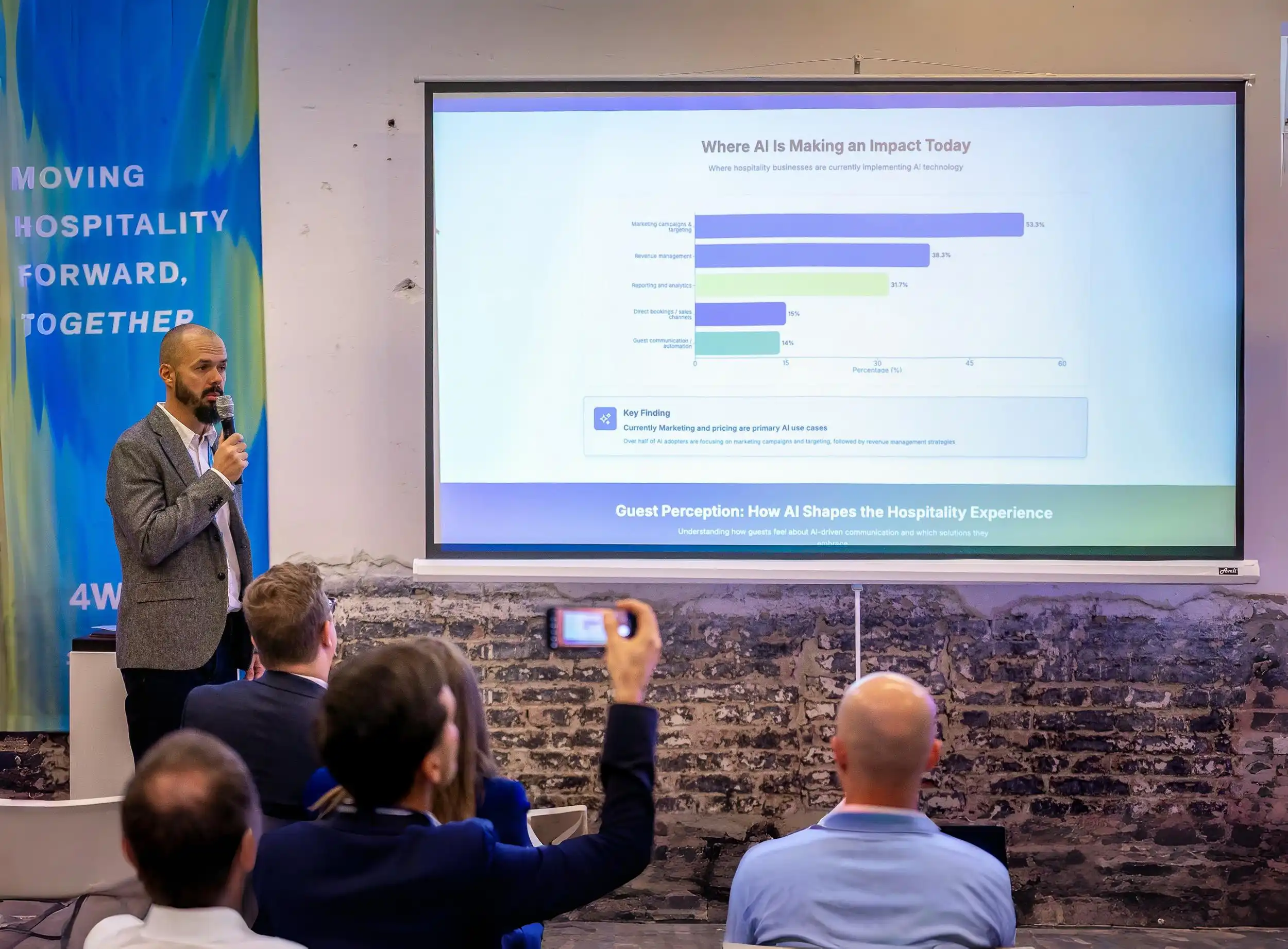
The research, titled AI in Tourism, was presented to industry professionals during a panel discussion at 4WARD by SabeeApp, the company’s largest event in Budapest. The findings were introduced by Szabolcs Herman, CEO of SabeeApp, and Dr László Kökény, Assistant Professor at Corvinus University.
Here’s what we learned:
- AI adoption starts in personal life and then transitions to professional
- AI is already making an impact in the hospitality industry
- AI and guest experience: more personalised and smooth
- AI is most trusted in data analysis
- AI holds tons of future opportunities for hoteliers
1. AI adoption starts in personal life and then transitions to professional
The aim of SabeeApp’s research is to understand how accommodation providers perceive artificial intelligence and how they currently use, or plan to use, AI-driven solutions in their operations.
Respondents represented a wide range of accommodation types, including hotels, guesthouses, hostels and private accommodations, enabling the research to reflect the sector’s diverse perspectives. While natural differences exist between these groups, clear sector-wide trends emerged that point towards the direction the industry is likely to take in the coming years.
The results showed that AI has already found its way into people’s personal routines: 75% of respondents already use AI-based tools in their personal lives.
Yet when it comes to hospitality operations, adoption is much lower. Nearly 60% of properties still don’t use AI at work.
But this is about to change fast. More than half of Hungarian accommodation providers plan to implement an AI solution within the next year. It’s a clear sign that AI is moving from a personal curiosity to something hoteliers want to rely on professionally.
2. AI is already making an impact in the hospitality industry
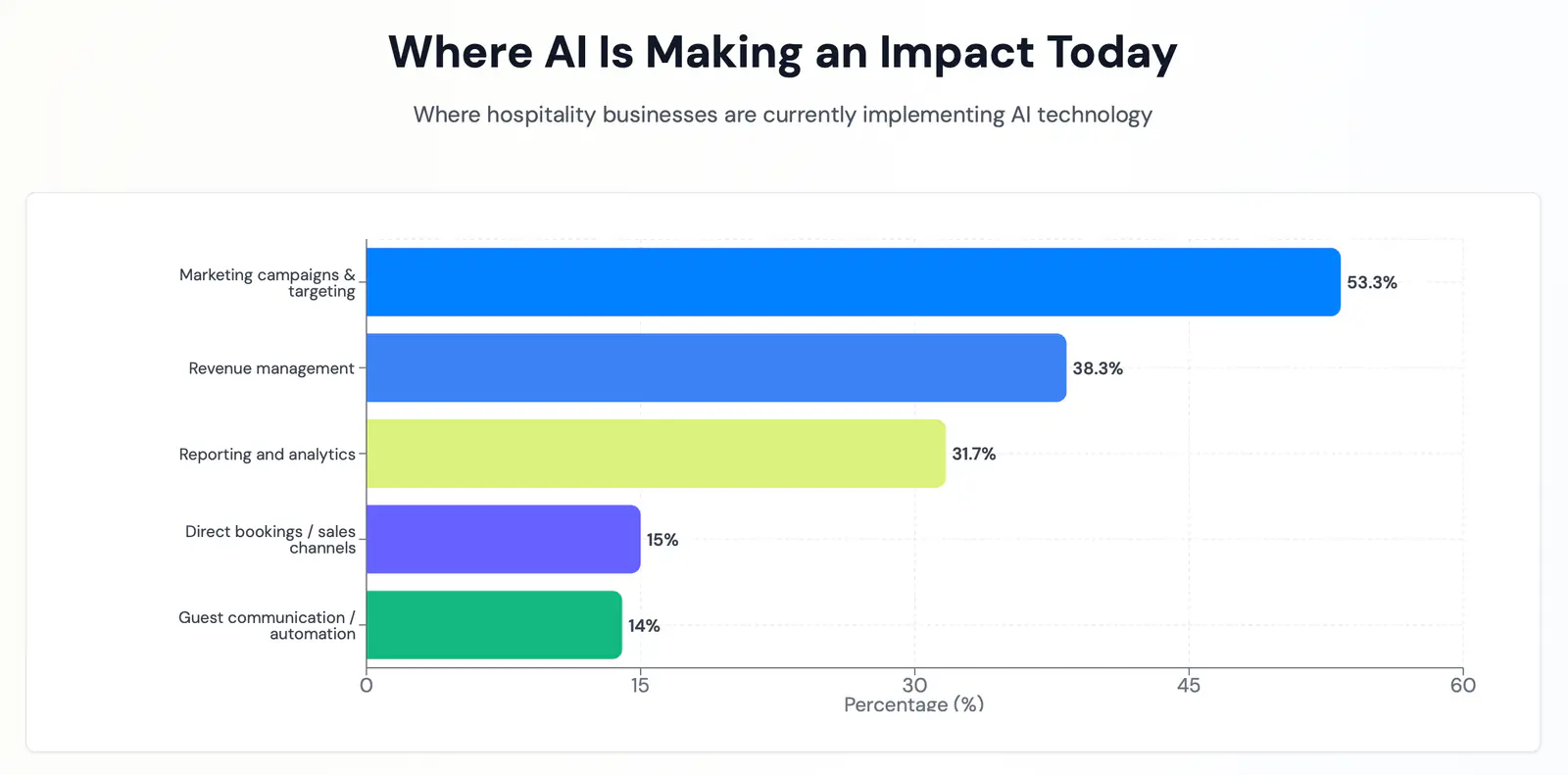
Even though AI adoption is still in an early phase, many professionals have already discovered its benefits. The survey shows that AI-based solutions are already helping hoteliers in their daily work and operational processes.
Three areas stood out:
- Marketing: content creation, brainstorming, social posts
- Guest communication: automated emails, chatbots
- Revenue management: intelligent pricing solutions
These are the areas where accommodation providers feel AI is already having a positive impact, helping them improve efficiency and performance.
Although many hoteliers are still only beginning to explore what is possible with AI, it is evident that artificial intelligence is becoming a strategic priority in the sector.
3. AI and guest experience: more personalised and smooth
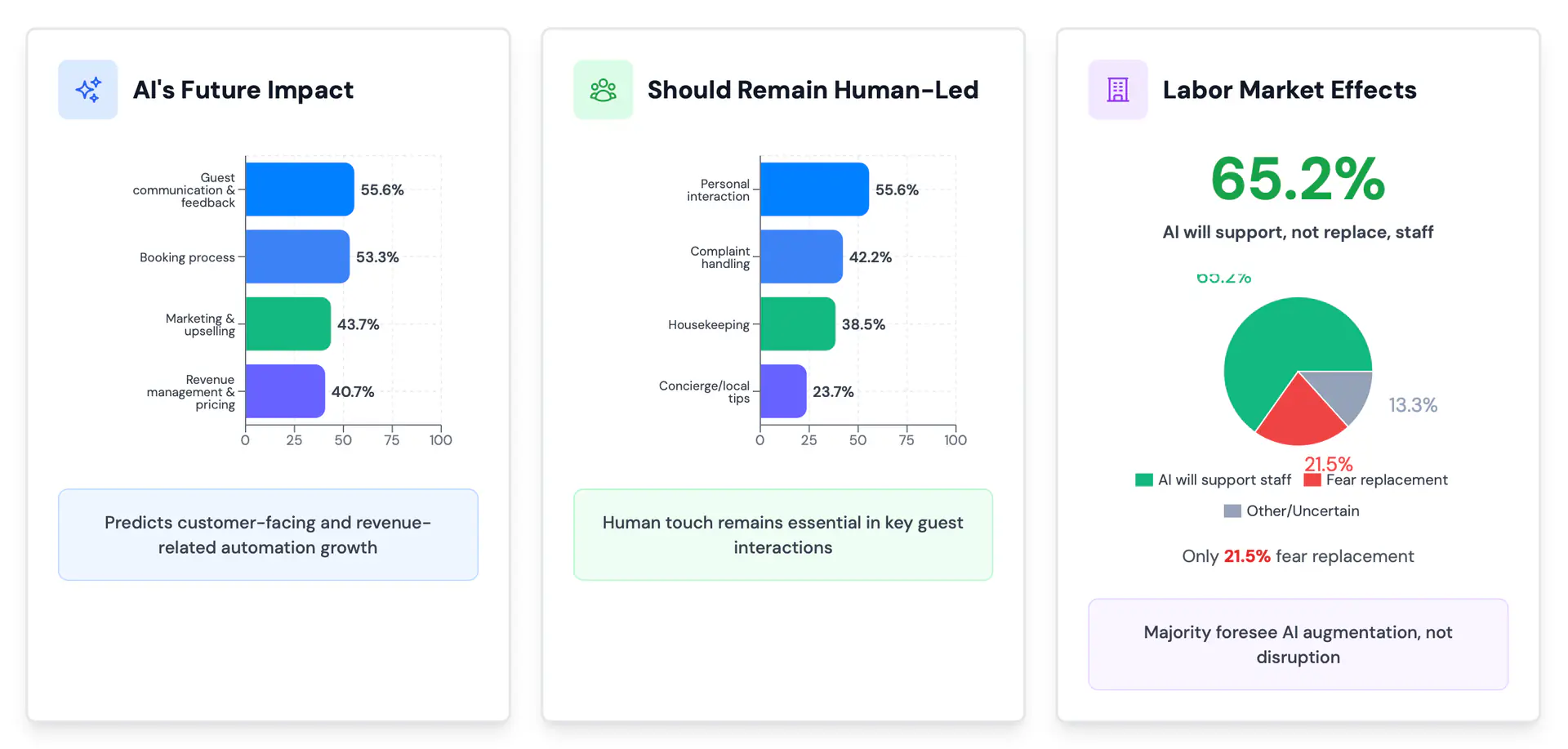
Hospitality is built on personal relationships, and hoteliers are very aware of this. Although some might have concerns regarding AI’s growing presence leading to a decline in personal interactions, 65% of accommodation owners and providers think that the appropriate use of AI could support human staff by freeing up time and resources, allowing them to focus on tasks that genuinely enhance guest satisfaction.
According to the respondents, AI can actually improve the guest experience:
- faster replies to questions
- more personalised communication
- smoother reservation processes
- fewer operational mistakes
The future, therefore, is not a choice between people and technology, but one in which human expertise and AI work in balance.
"AI will most probably not replace the warmth of human hospitality, and it should not. Its role is to make people’s work easier and more meaningful by taking care of repetitive, routine tasks that often slow teams down. We understand that changing well-established workflows can be difficult, but progress rarely happens without it. That is why at SabeeApp, we are integrating AI-driven solutions directly into our product stack, helping properties embrace innovation smoothly and achieve tangible value in their daily operations,"
said Szabolcs Herman, founder of SabeeApp.
4. AI is most trusted in data analysis
There are areas where professionals already trust AI more than human labour. A total of 47% of respondents said they trust AI-driven data analysis more than manual human calculations. The main reasons cited were the speed of AI and its ability to support more objective, data-driven decision-making, which can benefit management and long-term planning.
SabeeApp’s experts emphasise that this contrast is not a contradiction but an opportunity. The precision and speed offered by AI can be combined with a human-centred approach, as the two strengthen rather than replace each other.
5. AI holds tons of future opportunities for hoteliers
Most respondents believe AI will become mainstream in Hungarian hospitality within the next three years, and they expect its role to expand well beyond communication and marketing.
Possible future use cases include:
- more accurate forecasting and market trend predictions
- personalised upselling based on guest behaviour
- automated operations planning
- deeper integration between AI and PMS systems
It’s clear that hoteliers don’t imagine AI replacing staff, but they do see it as a strategic asset that helps properties become faster, smarter, and more competitive. Its usage holds great opportunities, and if Hungarian property owners and managers can overcome barriers such as lack of knowledge and practical experience, it can open new doors to the future of hospitality.
Key takeaways of the AI research
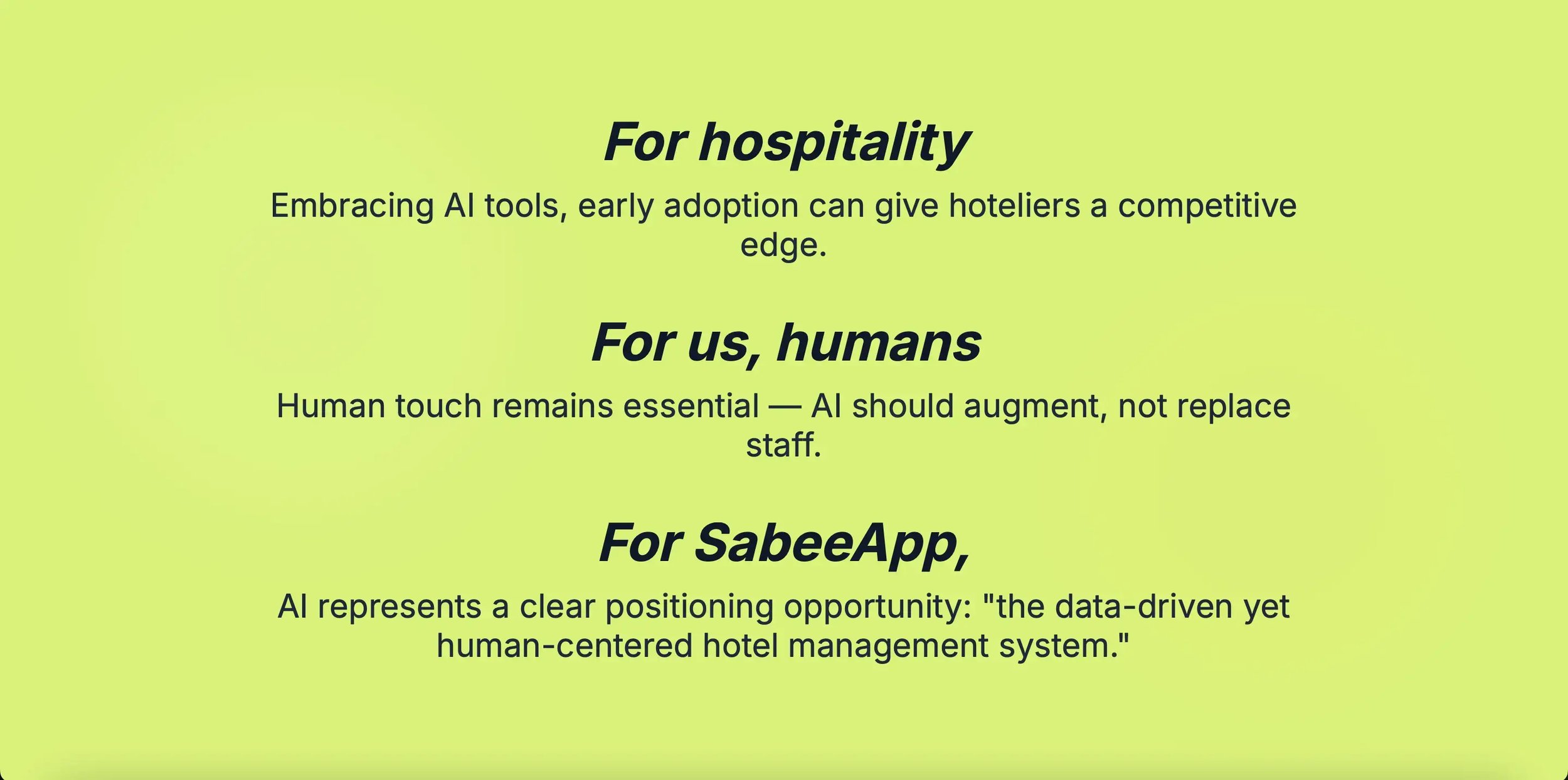
In summary, we can conclude that the future of AI in hospitality points toward strategic automation of customer-facing and revenue-generating functions while preserving human expertise in areas requiring empathy, complex problem-solving, and personalised service.
The research offers a clear overview and valuable insights into the current and future use of artificial intelligence in tourism and hospitality. Key conclusions include:
- AI is still used in a limited way but openness is high: most hoteliers plan to implement it within a year.
- The human factor and personal touch remain essential: AI is viewed primarily as a complement to human work, taking over repetitive, time-consuming tasks.
- The main barrier to AI implementation is the lack of expertise and education.
- There’s a growing trust in AI, especially in data accuracy as AI delivers faster and more objective decision-making.
You can access the full study here, including all graphs and results.